NBA Defensive Tendencies to Attack for Betting April 8th: Part 2
Best way to attack any sports bet is outliers and here I will be finding them and laying it out team by team as sort of a cheat sheet. Article covers Miami through Washington (alphabetical order).

How to view this data and understand what it means
When you look at these charts below, the most important thing to understand is that these numbers are not telling you whether a defense is “good” or “bad” in a vacuum. They are telling you what a defense is comfortable allowing. At the end of the day we want to attack outliers. Every value is ranked from 1 to 30, where 1 represents a defense that consistently limits that shot or action, and 30 represents one that gives it up often. That distinction matters, because in the NBA most defensive outcomes are the result of deliberate trade-offs. Teams don’t defend everything equally. They pick their poison, then live with the consequences.
Start with the shot type section: pull-ups, catch and shoot attempts, and shots inside ten feet. Pull up frequency is largely a window into how a team defends the ball. Defenses that rank poorly here are often playing some form of drop coverage, going under screens, or prioritizing rim protection over crowding the dribble. They are inviting guards to stop short and take jumpers, often betting that those shots won’t beat them over a full game. When a team ranks well at limiting pull ups, it usually means the opposite. They’re switching, chasing over screens, or meeting ball handlers higher on the floor. Those defenses make life harder for off the dribble scorers, but that pressure has consequences elsewhere.
Catch and shoot frequency tells a different story. High rankings here almost always point to aggressive help defense. These teams collapse early on drives, load the paint, and trust their rotations to recover. Sometimes it works. Sometimes it doesn’t. The contradiction is that a defense can look “active” and disciplined while still giving up a steady diet of open threes. Teams that rank well at limiting catch and shoots tend to stay home on shooters, switch more frequently, and rely on individual containment rather than help. That can suppress perimeter looks, but it also puts stress on on-ball defenders and rim protectors.
Shots allowed inside ten feet are the loudest signal on the board. If a team ranks poorly here, it usually means something is breaking down such as weak rim protection, late low-man rotations, guards getting beat cleanly off the dribble, or all three. Paint scoring is rarely something a defense chooses to allow. Teams that rank well in this area are doing the hardest thing in basketball: deterring shots at the rim without completely selling out to do so. That often forces opponents into jump shots, whether they want them or not.
The play-type section adds context to all of this. Pick and roll ball handler scoring often aligns with pull up tendencies and point of attack (POA) defense. Roll man scoring exposes tagging and backside help. Spot up scoring usually tracks directly with catch and shoot frequency and how aggressively a team helps off shooters. Isolation performance reflects personnel as much as scheme, while post ups and putbacks tend to highlight size, rebounding, and physicality rather than tactical choices. In other words, this section explains how offenses are cashing in on the shot types shown above.
The real value comes from reading these sections together, not individually. A team that allows a lot of pull-ups but very little at the rim is likely playing a conservative, rim-first style. A team that suppresses pull-ups but bleeds catch-and-shoots is probably helping early and rotating often. A defense that ranks poorly in both paint scoring and roll-man production is signaling structural issues, not just bad luck. Patterns matter more than single numbers.
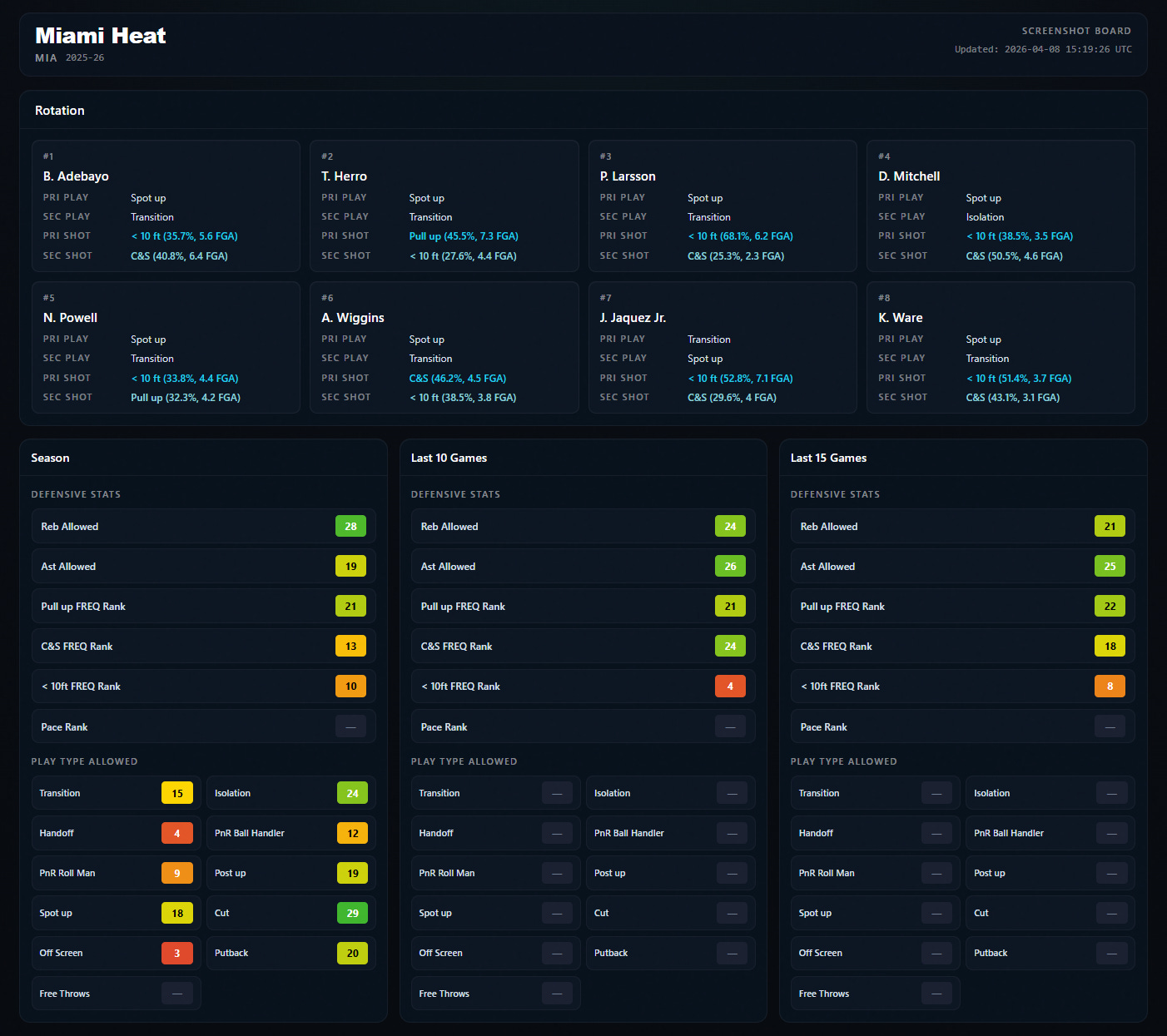
Miami Heat
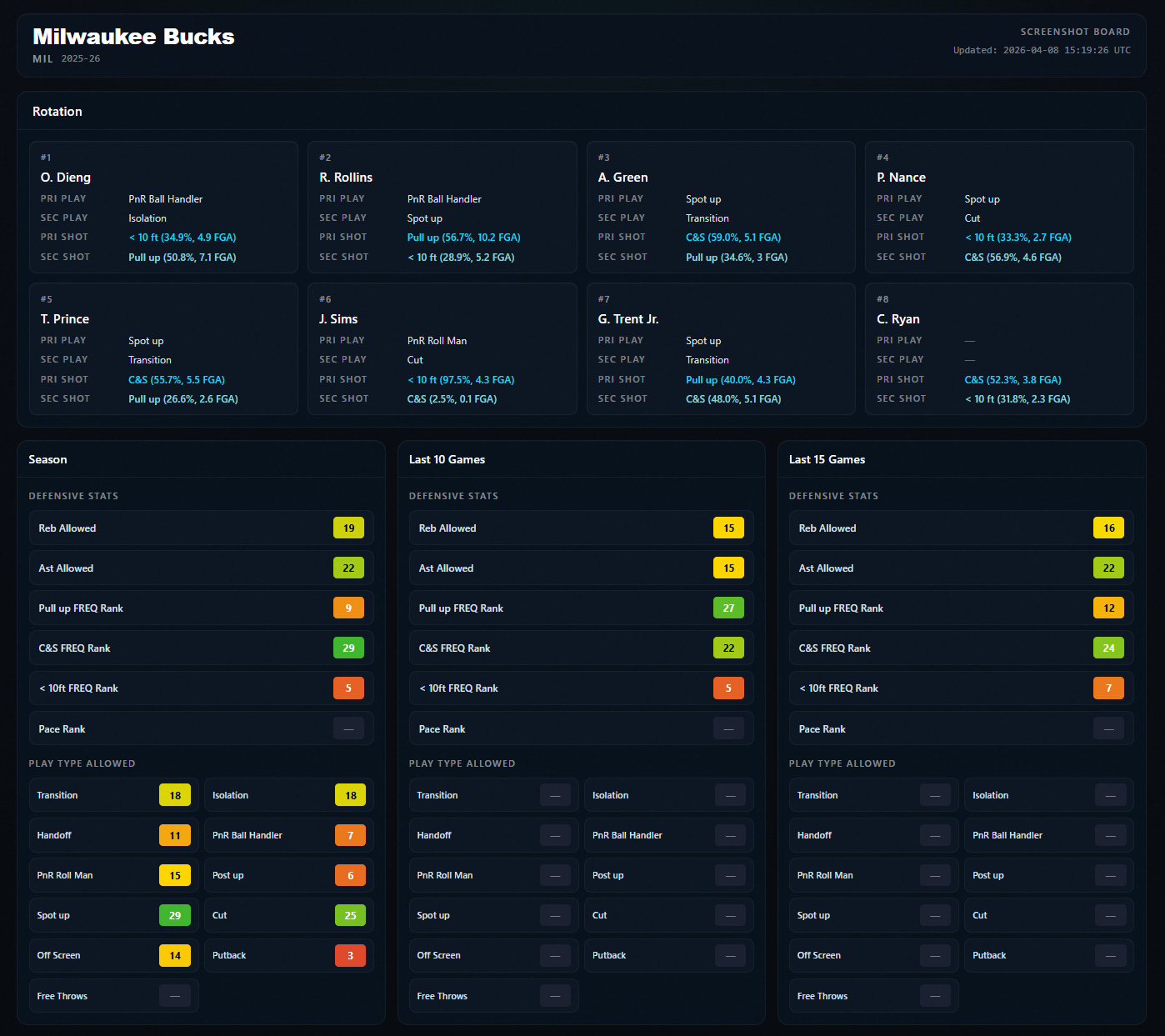
Milwaukee Bucks
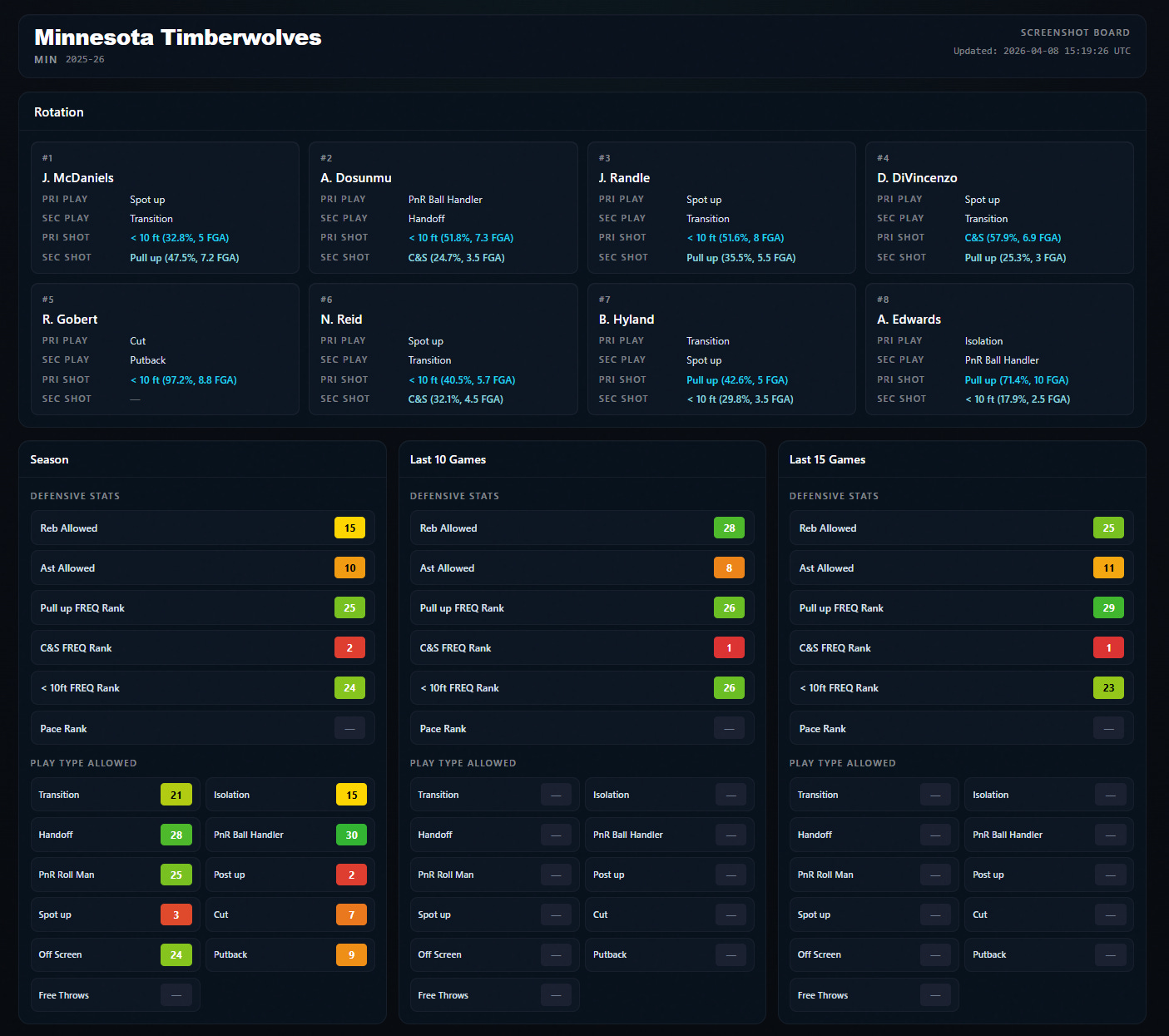
Minnesota Timberwolves